

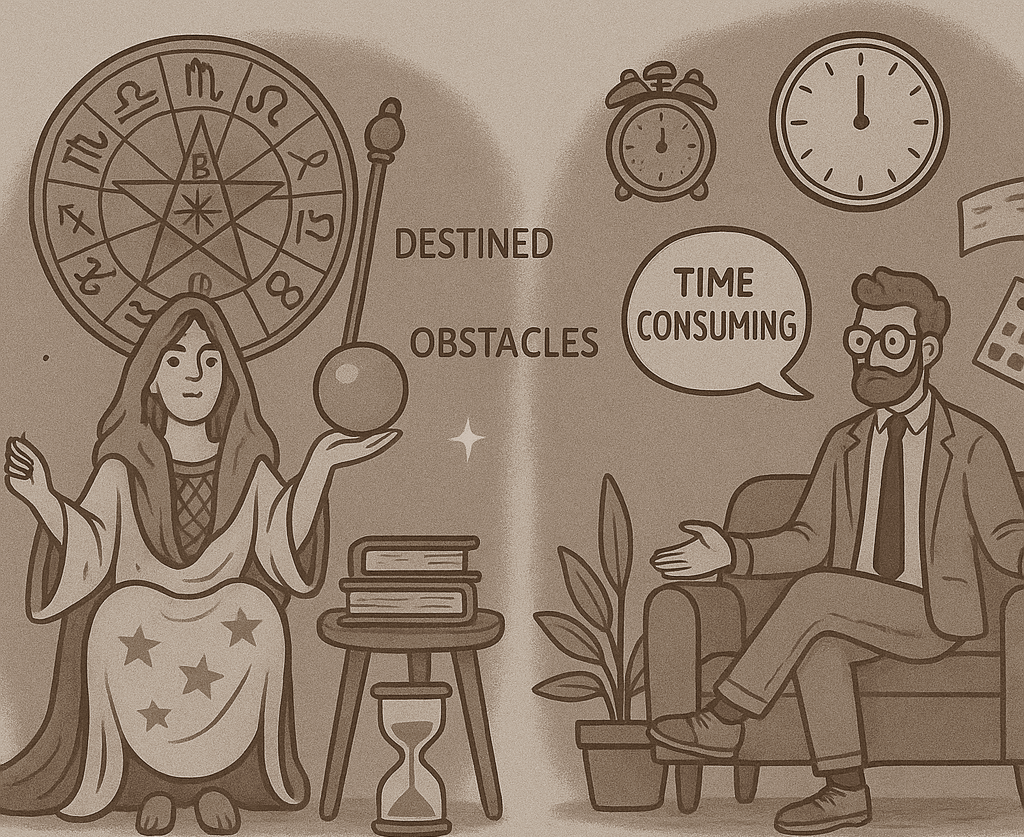
The Star Psychology adventure
Therapy with a roadmap
In 2025 I started the Star Psychology project, a cross-fertilization of my experience as a Transpersonal Psychologist and my interest in Human Design and Astrology. This form of psychological astrology can be used as a creative additional tool in the therapeutic counselling process.
Focus: Unlike classical astrology, which often focuses on predicting future events, Star Psychology uses the birth chart as a “map” of the psyche to understand inner patterns, strengths, weaknesses, and unconscious drives. However, since the map is never just the territory, it’s the therapeutic process that makes this potential blueprint come alive.
Over the years I have come to understand which aspects of these traditions are most helpful to my clients on their self development journeys. And as clients began to show increasing interest, I translated the rather archaic wording of astrology and Human Design into a into a practical, creative and playful language that suits my way of working.
We now have a family of sixty-four archetypes that are instantly recognisable and practical to work with. I focus on five archetypes as the most influential in a chart; the so called Fab Four, and the shifting influence of your Moody Moon.
When you embark on the Star Psychology adventure you receive a tailormade life guide based on your birth chart. You also receive a private deep dive podcast giving you another way of processing this rich information. In addition to this basic package there is a full package that includes two guidance sessions and some personalised grounding material. And finally, for a gentler start to your adventure, you can take part in one of the workshops that are held online, and in Amsterdam, The Hague and Stockholm.
Have I made you curious? Then check out the video below or go straight to the Star Psychology website.
But first read some of enthusiastic testimonials from happy clients at the bottom of the page.
-
WoW....wowowow... JUST mind blowing! This absolutely blew my mind… and wow, I must’ve been very optimistic (or a little drunk 😄) when I picked those horses!
- Bo *March 2026
-
"The life guide is clear, with a distinct voice that I truly appreciate. It is well researched, and I love that you use your own language to make it unique.
- Karolina 2025
-
"Lysanne is a star at providing friendly guidance and explanations with a genuine heart for people.
— Minke 2025
-
"It was like seeing me on paper."
— Aisha, 2025
-
Your examples and simpler comparisons were fantastic. That often made things much clearer and easier for me to put into context
— Maria 2025